China Owns Africa’s Telecoms, here are the numbers

The Africa Telecoms scene is still in its infancy and quite dynamic. As of 2019, 477 million Africans had access to mobile networks which accounts for 45% of the continental population. Chinese companies are the dominant brands in telecommunications infrastructure and have become leaders regarding mobile devices making use of the said infrastructure. Transsion brands (Tecno, Itel, and Infinix) are setting their roots in the African market and claiming market share from legacy brands like Samsung and Apple.
The telecoms vendors in Africa
The dominant vendors on the African continent are Huawei, ZTE, Ericsson, and Nokia with Ericsson being the legacy vendor in a number of markets. Ericsson's first entry onto the continent was in 1896 (127 years ago) in South Africa. From there it expanded to become the de facto vendor for most of Africa long before the existence of Nokia as an equipment vendor (1979), ZTE in 1985, and Huawei in 1987. Huawei and ZTE would only enter into Africa in the late 1990s.
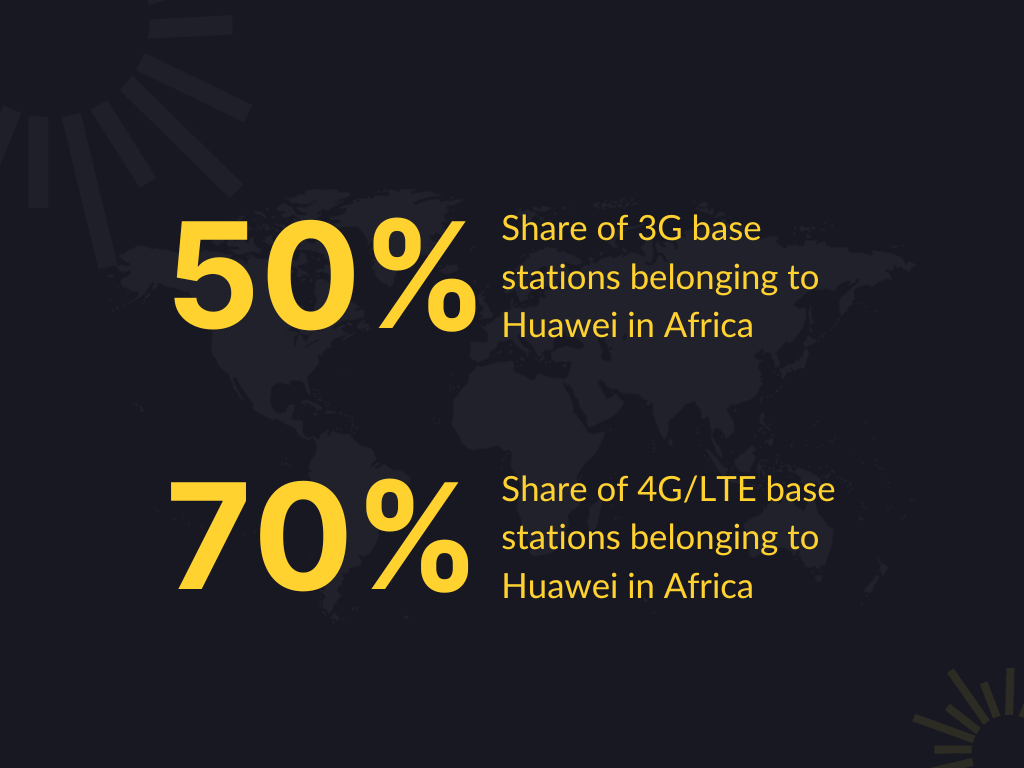
A number of Africa's core networking systems as well as 2G and 3G networks are predominantly Ericsson hardware as this was the main vendor and equipment supplier pre-2000. From 2000, China's infrastructure developments in Africa increased significantly with a 46.1% year-on-year improvement between 2001 and 2007. China's 'go out policy' enacted in 1999 was the main driver of Chinese technology proliferating outside of China. This policy was further buttressed by the Chinese government financing projects in Africa including telecommunications projects. In Africa, Huawei provides equipment for 50% of 3G networks and 70% of 4G networks, while ZTE accounts for 20-30% of 3G coverage.
A big push for underserved Africa
The rise of Chinese vendors on the continent came about in the early 2000s. China was on the verge of expanding its trade with the rest of the globe and in so doing, they set up the Go Out Policy in 1999. Between 2005 and 2020, Chinese technology and contract investments amounted to US$7.19 billion in Sub-Saharan Africa. This led to several telecommunications projects being deployed on the continent with Huawei and ZTE at the forefront of telecommunications projects. These projects are inclusive of data centers, backbone fiber networks, and e-government solutions.