State of SADC rail for logistics & passenger transport: One SA company owns 70% of traffic
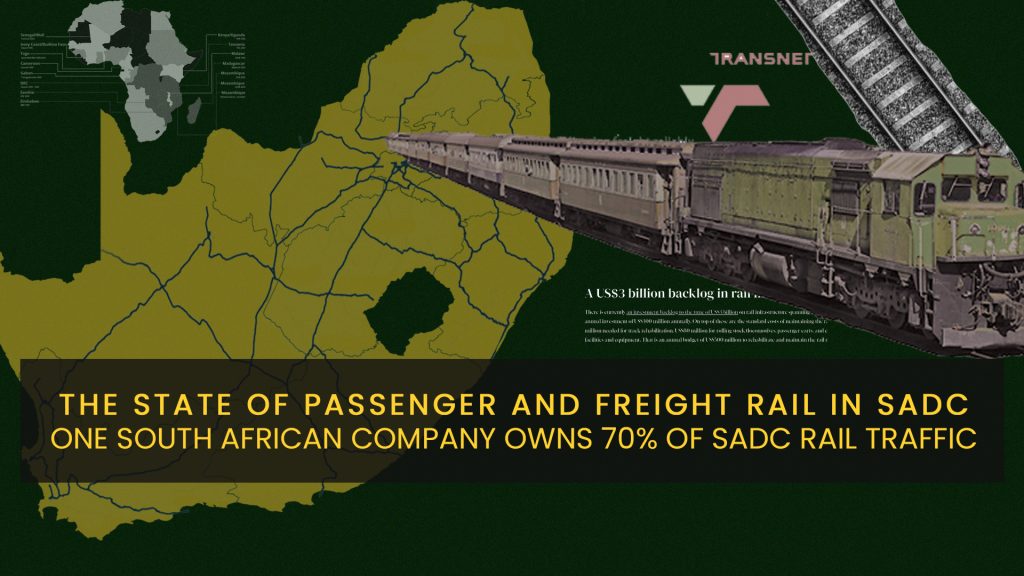
The state of rail for logistics and passenger transport in the Southern African Development Community (SADC) is a far cry from where it could be. Just as a quick refresher, there are 4 main modes of freight of goods and passengers road, rail, maritime, and air. Of all those, rail stands at 0.3% share of total passenger freight and logistics volumes in Africa. Rail in SADC is operating below capacity and is not coordinated at a regional level but functions as a collection of national systems.
South Africa has the longest rail network on the continent
What's curious about these numbers, as low as they are, is that Southern Africa's total rail network is 44.25% of the total rail network on the continent. Of the 86,820km of rail on the continent, 38,415km is in SADC and South Africa alone has a rail network spanning 21,565km - 56% of the total length of rail in the region.

To bring all of that more into perspective, 13 countries in Sub-Saharan Africa have no operating railway. Furthermore, 50 companies operate around 55,000km of rail in sub-Saharan Africa, a majority of them being small operators. Transnet Freight Rail or TFR (formerly known as Spoornet), a single company in South Africa represents 40% of the operating rail network and 70% of the rail traffic.

All that being said, Southern Africa is a good way ahead of the rest of Africa when looking at the route-km of rail in operation. It stands at 34,173km versus a combined 33,282km for North, Central, East and West Africa. North Africa has the largest passenger traffic on its rail at around 46 billion passenger-km primarily in Cairo and Alexandria. And Southern Africa comes in second at 13.5 billion passenger-km. Of that, around 10.8% of North Africa's rail passengers are suburban with the rest being non-urban. In Southern Africa, this trend is the reverse with 85.2% being suburban passengers and 14.2% non-urban passengers.
Tagged: Afcfta, Transnet